
Choosing the right drill bit length plays a critical role in hard rock drilling performance. The correct length directly affects drilling accuracy, penetration efficiency, and tool stability. Many drilling issues, such as deviation or premature wear, can be traced back to improper bit length selection in demanding geological conditions.
In hard rock applications, drill bit length must balance depth requirements with control and power transfer. Factors like hole depth, rock hardness, drilling equipment, and project efficiency all influence the ideal size. Understanding these considerations helps operators reduce downtime and achieve safer, more consistent drilling results.
What is Drill Bit Length?
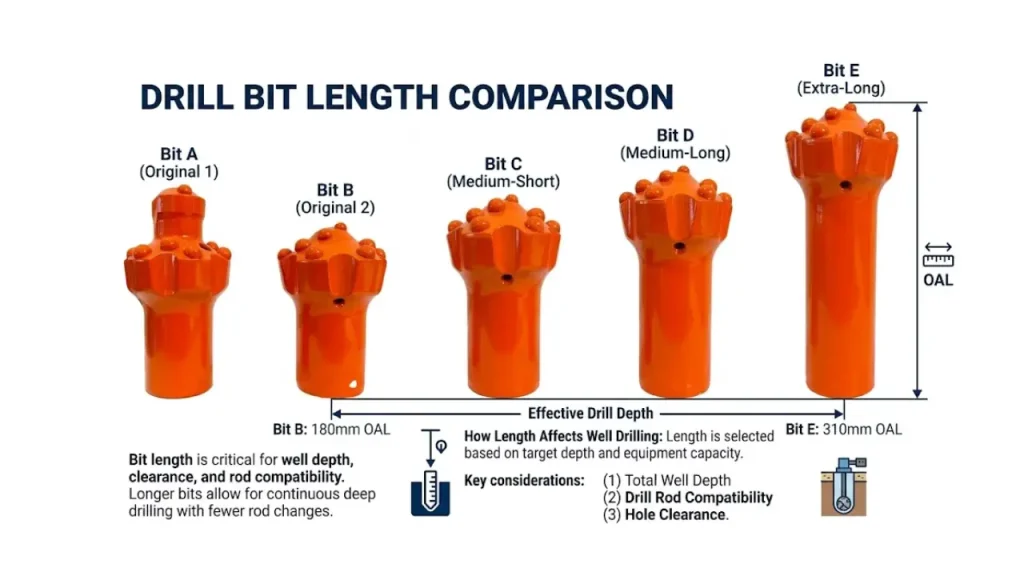
Drill bit length refers to the total length of a drill bit from the tip to the shank end. It determines how deep a hole can be drilled in a single operation.
Choosing the correct drill bit length ensures better stability, accurate hole depth, efficient power transfer, and reduced vibration during drilling, especially in hard rock applications.
How to Measure Drill Bit Length?
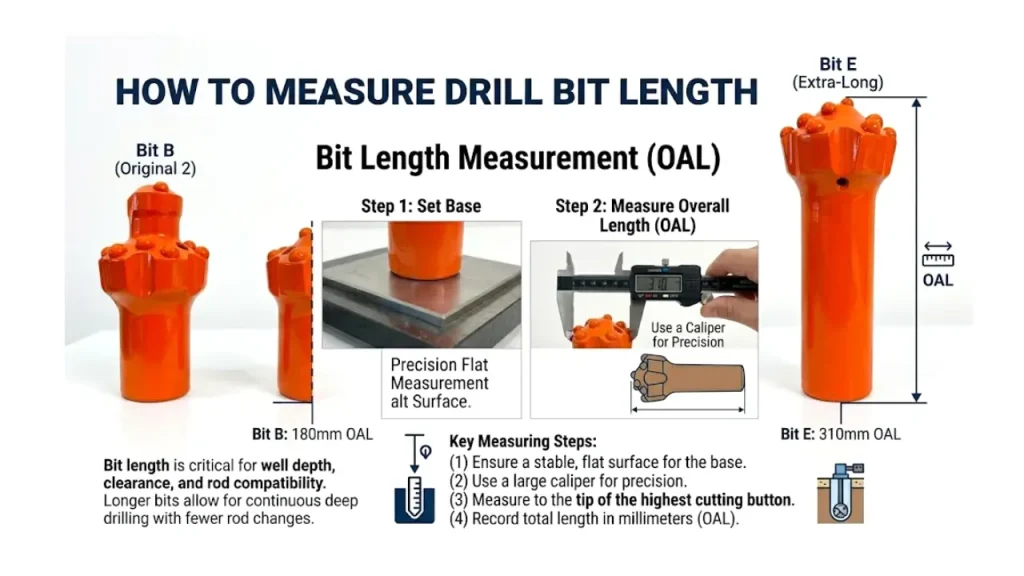
Measuring drill bit length correctly is essential for accurate drilling, proper tool selection, and safe operation. Different drilling tasks require different length measurements, especially in rock drilling where depth, stability, and power transfer matter.
Understanding how to measure overall length and usable drilling length helps operators avoid errors and ensure consistent performance on site.
Tools Needed
- Measuring tape or steel ruler
- Flat work surface
- Vernier caliper (optional for precision)
- Marker or notepad for recording values
Step 1: Measure the Overall Length
Place the drill bit flat on a stable surface with the tip fully aligned at the zero mark of a ruler or measuring tape. Measure straight to the very end of the shank. This total length represents the maximum reach of the drill bit during operation.
Ensure the drill bit is not angled or lifted during measurement, as this can distort results. For rock drill bits, overall length is critical when matching bits to drill rods and rigs. Record the measurement clearly to avoid confusion during installation or replacement.
Step 2: Measure the Usable Drilling Length
Identify the point where the shank ends and the working section begins, usually marked by the shoulder or flute start. Measure from the tip of the drill bit to this point. This distance defines how deep the bit can drill effectively into rock.
Usable length is especially important in hard rock drilling, where penetration depth affects efficiency and stability. Measuring this length accurately helps operators plan drilling depth, reduce rod changes, and prevent overloading equipment during demanding drilling applications.
Common Drill Bit Lengths in the Drilling Industry
Drill bit length is a key specification in rock drilling, directly affecting hole depth, stability, and drilling efficiency. In mining, quarrying, tunneling, and construction, standard rock drill bit lengths are widely adopted to match drilling rigs, rock hardness, and operational needs. Below are the most commonly used lengths and their typical applications.
- 400 mm – Common for shallow rock drilling and scaling work, offering strong rigidity and precise control.
- 450 mm – Used in bench drilling where short, accurate holes are required in hard formations.
- 500 mm – Suitable for surface drilling and controlled blasting preparation.
- 550 mm – Balances depth and stability for light mining and quarry operations.
- 600 mm – Frequently applied in construction rock anchoring and foundation drilling.
- 650 mm – Ideal for slightly deeper holes while maintaining good energy transfer.
- 700 mm – Used in quarry face drilling and small tunnel projects.
- 750 mm – Popular in mining for medium-depth blastholes.
- 800 mm – Supports deeper penetration with acceptable vibration control.
- 900 mm – Often selected for bench drilling in hard rock environments.
- 1000 mm – Standard length for mining and tunneling starter holes.
- 1100 mm – Allows deeper drilling without frequent rod changes.
- 1200 mm – Common in underground mining and long-hole drilling setups.
- 1400 mm – Suitable for deeper blast holes with stable drilling rigs.
- 1600 mm – Used in production drilling where longer reach is required.
- 1800 mm – Applied in tunneling and mining for extended hole depth.
- 2000 mm – Popular in long-hole drilling and controlled blasting operations.
- 2400 mm – Designed for deep rock drilling with high-powered rigs.
- 3000 mm – Used in specialized mining and tunneling applications.
- 3600 mm – Suitable for long-hole production drilling in hard rock.
Common Rock Drill Bit Lengths Chart
| Drill Bit Length (mm) | Typical Application |
|---|---|
| 400–600 | Shallow drilling, construction, anchoring |
| 650–900 | Quarrying, bench drilling |
| 1000–1200 | Mining, tunneling starter holes |
| 1400–1800 | Medium to deep mining drilling |
| 2000–2400 | Long-hole drilling |
| 3000–3600 | Shallow drilling, construction, and anchoring |
Why Is Proper Drill Bit Length Important?
Choosing the proper drill bit length is critical for drilling efficiency, safety, and tool longevity, especially in hard-rock applications. An incorrect length can lead to poor penetration, excessive vibration, or premature wear. Understanding why drill bit length matters helps operators improve drilling accuracy, reduce downtime, and achieve more consistent results in demanding working conditions.
- Drilling Stability and Accuracy – Proper drill bit length ensures better rigidity and balance during operation, reducing bending and vibration in hard rock drilling while maintaining straight holes, accurate alignment, cleaner results, and less stress on both the drill bit and drilling equipment.
- Penetration Efficiency – The correct drill bit length allows effective energy transfer from the drill to the rock, preventing power loss caused by excessive length while avoiding depth limitations from short bits, resulting in faster drilling speed, improved penetration, and higher overall productivity.
- Tool Life and Cost Control – Using the right drill bit length minimizes uneven wear, overheating, and mechanical stress, reducing breakage risks, extending service life, lowering replacement frequency, and helping control operating costs in mining, quarrying, and construction drilling operations.
- Operational Safety – Proper drill bit length improves stability and control, reducing uncontrolled vibration, tool deviation, and sudden failures, which enhances operator safety and creates a more reliable and secure drilling environment in demanding hard rock conditions.
Customize Your Desired Drill Bit Length from Sinodrills
Customizing the drill bit length enables better efficiency, accuracy, and adaptability in hard-rock conditions. Standard sizes do not always meet project-specific requirements, especially in mining, quarrying, and tunneling. Sinodrills offers flexible customization options to match drilling depth, equipment compatibility, and site conditions precisely.
- Project-Specific Length Options – Sinodrills provides customized drill bit lengths based on your required hole depth and drilling method. Whether for shallow anchoring or deep production drilling, tailored lengths help maintain stability, improve energy transfer, and reduce unnecessary rod changes during demanding rock drilling operations.
- Compatibility with Drilling Equipment – Customized drill bit lengths are designed to match your drilling rigs, rods, and couplings. This ensures smooth installation, balanced operation, and reliable performance, helping prevent misalignment, excessive vibration, or premature wear caused by mismatched standard-length drill bits.
- Improved Drilling Efficiency – Selecting the exact drill bit length improves penetration speed and drilling consistency. Customized lengths reduce energy loss and vibration, allowing more efficient impact transmission into hard rock. This leads to faster drilling cycles, reduced downtime, and higher productivity across different drilling applications.
- Consistent Quality and Supply – Sinodrills maintains strict manufacturing controls for customized drill bit lengths, ensuring durability and performance consistency. Reliable supply, precise machining, and dependable materials help customers achieve stable drilling results while optimizing long-term operational costs in mining and construction projects.
Conclusion
Selecting the proper drill bit length is not just a technical detail but a strategic decision in hard rock drilling. The right size improves penetration efficiency, minimizes vibration, and enhances hole accuracy. By matching bit length to rock conditions and drilling goals, operators can significantly improve productivity and extend tool life.
Shorter drill bits offer greater rigidity and control for shallow or precision drilling, while longer bits are better suited for deeper holes. However, excessive length can reduce stability and power transmission. Evaluating drilling depth, equipment capability, and rock strength ensures a balanced and effective choice.
Ultimately, reliable drill bit performance depends on both correct selection and dependable supply. For consistent results in hard rock projects, get wholesale rock drill bits from our Sinodrills, designed to deliver durability, efficiency, and dependable performance across demanding drilling environments.