
Drill tube and guide tube have comparatively thicker walls than standard drill rods, performing much better in deep‑hole work. To prevent drill string tilt and keep the drill string stable on‑site, it is important to understand how they differ from one another.
In top-hammer drilling tools, the drill tube and guide tube both fall under the top hammer drill rod category. However, they differ greatly in definition, core functions and connection configuration.
What is a Drill Tube?
Drill tube is a thick-walled hollow extension rod for mid-string deep hole extension, impact & torque transmission.
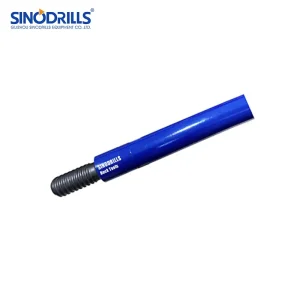
Key Functions
Reinforcing the Drilling System:
Compared with solid speed rods, the drill tube has a larger diameter to withstand impact energy, which enhances the stability of the drilling system.
Impact Energy Transfer:
The shoulder on the drill tube helps to transfer the impact energy more uniformly and efficiently, which is ideal for dense or corrosive rock formations.
Deep Hole Drilling:
Multiple drill tubes can be connected to form a drill string to reach greater depth.
Making the Borehole Wall stable:
Drill tubes provide strong structural support, which boosts structural support to mitigate collapse and deviation risks in fractured strata.
What is a Guide Tube?
Guide tube is a large outer diameter heavy-wall component installed directly behind drill bit for borehole deviation control.
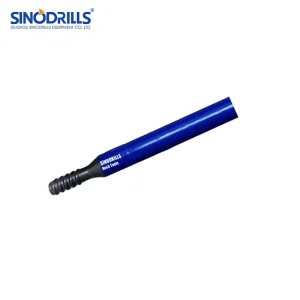
Key Functions
Precise Drill Bit Guidance:
Guide tube prevents the drill string head from bending or shifting, restricting radial displacement of the drill bit and keeping it on the planned drilling path.
Ensuring Drill Hole Straightness:
The guide tube has a large outer diameter and thick walls, allowing it to fit snugly against the borehole wall.
The whole drill string maintains straightness, even under challenging geological conditions while drilling inclined or deviated boreholes.
Connection Configurations of Drill Tube and Guide Tube
With the shank adapter as the fixed starting component, drill tubes and guide tubes differ in connection interfaces with the drill bit.
With the shank adapter as the fixed starting component, drill tubes and guide tubes differ in connection interfaces with the drill bit.
Drill tube: Capable of direct connection to the drill bit.
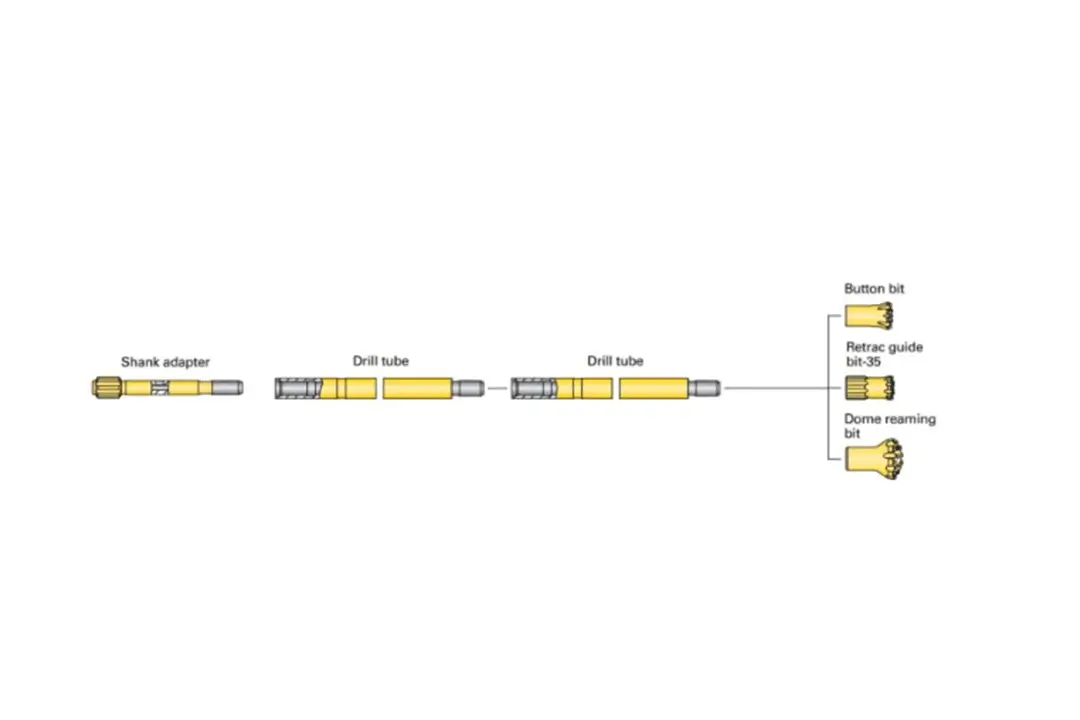
The drill tube can be connected to different types of drill bits, including but not limited to: button bit, retrac guide bit-35, and dome reaming bit.
Guide tube: Two connection variants exist, as shown in the schematic:
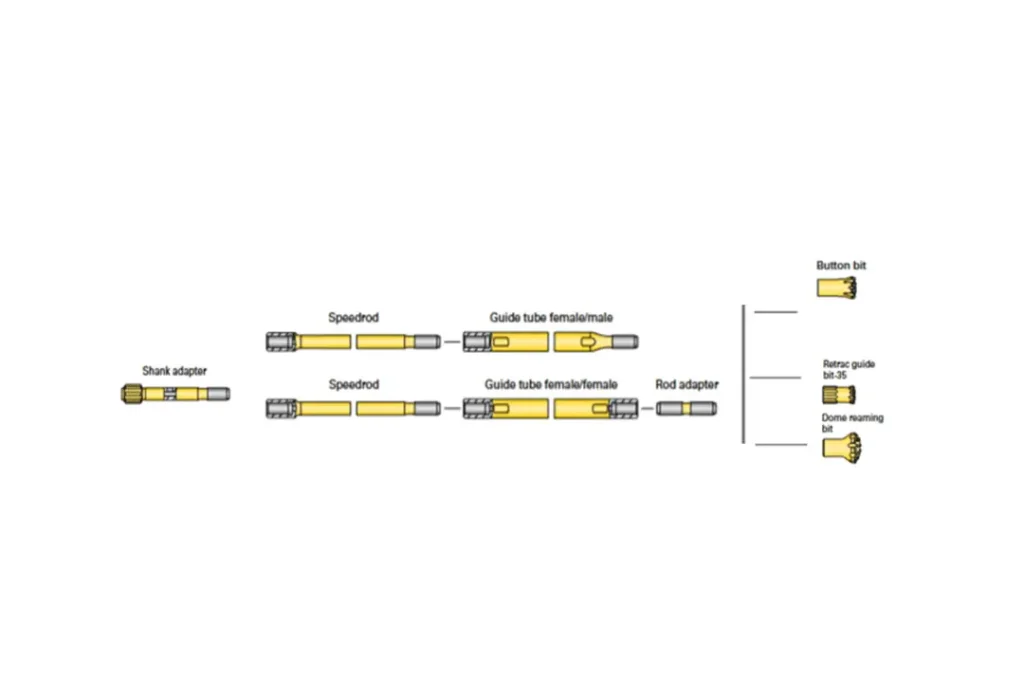
Female‑male (MF) guide tube: Direct attachment to the drill bit with no additional parts required.
Female‑female (FF) guide tube: A rod adapter is mandatory to bridge the guide tube and drill bit for assembly.
Types of Drill Tube and Guide Tube
Besides differences in thread type, drill tubes and guide tubes, even with the same thread and size, also differ in length and weight.
longer tubes are applicable for surface or tunnel construction conditions with ample space. The rod connection times and cutting impact energy loss are minimized because of their weight and length. Here are some long tubes: 3660mm drill tube, 3050mm guide tube, and 4270mm drill tube.
Shorter tubes are more suitable for underground or narrow tunnel construction conditions, offering greater flexibility, easier replacement, and cost savings.
SINODRILS Guide Tube Product Specification
| Thread | Outer diameter | Length (L) mm | Length (ft) foot | Weight approx. kg |
| R32 | 45 | 915 | 3 | 9 |
| 45 | 1220 | 4 | 10 | |
| 45 | 1830 | 6 | 14.2 | |
| 45 | 3050 | 10 | 23.4 |
| Thread | Outer diameter | Length (L) mm | Length (ft) foot | Weight approx. kg |
| T38 | 56 | 1220 | 4 | 12.6 |
| 56 | 1525 | 5 | 14 | |
| 56 | 1830 | 6 | 17.4 | |
| 56 | 3050 | 10 | 28.3 | |
| 56 | 3660 | 12 | 32.8 |
| Thread | Outer diameter | Length (L) mm | Length (ft) foot | Weight approx. kg |
| T45 | 64 | 1220 | 4 | 20 |
| 64 | 1525 | 5 | 21.6 | |
| 64 | 1830 | 6 | 25.4 | |
| 64 | 3050 | 12 | 49 |
| Thread | Outer diameter | Length (L) mm | Length (ft) foot | Weight approx. kg |
| T51 | 76 | 1830 | 6 | 40 |
| 76 | 3660 | 12 | 79.1 |
| Thread | Outer diameter | Length (L) mm | Length (ft) foot | Weight approx. kg |
| EL60 | 87 | 1220 | 4 | 32 |
| 87 | 1525 | 6 | 46 | |
| 87 | 3660 | 12 | 90 | |
| 87 | 4265 | 14 | 108 |
SINODRILS Drill Tube Product Specifications
| Thread | Outer diameter | Length (L) mm | Length (ft) foot | Weight approx. kg |
| ST58 | 76 | 1220 | 4 | 27 |
| 76 | 1525 | 5 | 34 | |
| 76 | 1830 | 6 | 40 |
| Thread | Outer diameter | Length (L) mm | Length (ft) foot | Weight approx. kg |
| ST68 | 87 | 1220 | 4 | 32 |
| 87 | 1525 | 5 | 40 | |
| 87 | 1830 | 6 | 47 |
| Thread | Outer diameter | Length (L) mm | Length (ft) foot | Weight approx. kg |
| GT60 | 87 | 915 | 3 | 27 |
| 87 | 1830 | 6 | 46 | |
| 87 | 2435 | 7 | 17.4 | |
| 87 | 2700 | 8 | 67 | |
| 87 | 2900 | 9 | 72 | |
| 87 | 3660 | 12 | 90 | |
| 87 | 4270 | 14 | 104 |
Guide Tube vs. Drill Tube
Drill tubes and guide tubes are used in different scenarios and under different conditions.
we can compare them in the following respects to help readers understand the differences between the two more clearly.
| Comparison Dimension | Guide Tube | Drill Tube |
| Installation Position | Installed immediately behind the drill bit, at the foremost end of the drill string | Middle segment of the drill string, between the shank adapter and guide tube/drill bit |
| Core Function | Suppress borehole deviation and ensure linearity | Extend the drill string, transmit impact torque, and reinforce the drill string |
| Outer Diameter Feature | Larger outer diameter matching the thread specification, fitting closely to the borehole wall | Smaller outer diameter with a clearance from the borehole wall |
| Tube Wall Structure | Thickened wear-resistant outer wall with high bending resistance | Thick-walled hollow structure with a large flushing and slag discharge channel |
| Feasibility of Independent Hole Extension | No, only single-section centralization is achievable | Yes, multi-section series connection enables deep-hole drilling |
| Typical Applicable Working Conditions | Inclined holes, high-precision exploration, complex fractured rock formations | Underground long holes, deep bench drilling in hard rock, holes over 30 m deep |
The guide tube constrains the drill bit and ensures borehole perpendicularity.
The drill tube is responsible for depth extension, transmitting impact and torque, and improving the overall rigidity of the drill string.
How to Select Drill Tube and Guide Tube
Confirm shank type:
Check the spline and thread types on the shank and select the appropriate drill pipe to ensure that the drill string can withstand the rotational torque and maintain stability.
Clarify formation conditions:
Fractures within the formation can cause the drill bit to veer off course; the use of guide tubes can help to realign the bit and maintain the straightness of the borehole.
Check drilling depth:
Standard shallow drilling projects can rely on speed rods paired with guide tubes, while holes deeper than 30 meters demand drill tubes for added rigidity.
Determine whether inclined drilling is required:
For the same thread size, the outer diameter of the guide tube is bigger than that of the drill tube; the closer the outer diameter is to the drill hole, the more effective the deviation correction.
Why choose us?
SINODRILLS has been deeply involved in the rock drilling tool industry for over 20 years, collaborating with clients in 110 countries and regions worldwide.
With extensive industry experience, we are confident we can provide you with professional services.
Drill tubes and guide tubes play different roles in underground drilling projects. Careful selection can improve efficiency and reduce costs for your project.
Contact us for more detailed product information.
Q1: Which Types of Drill Tubes Are Commonly Used in Construction Project?
Drill tube st68 1830mm. Actually, The st68 drill tube and st58 drill tube are widely adopted across mining and tunneling sites.
Q2: Is a Guide Tube Always Manufactured With a Larger Outer Diameter?
In most applications, the guide tube has a larger outer diameter than the drill tube of the same specifications.
Q3: Where in the drill string is a guide tube typically placed?
A guide tube is typically positioned directly behind the drill bit or adapter, acting as the leading element of the Bottom Hole Assembly (BHA) to stabilize the bit as it impacts the rock face.
Q4: Can Drill Tubes and Guide Tubes Be Used Together in the Same Drill String?
Yes.
In challenging geological conditions or long-hole underground drilling, a guide tube is often placed at the front of the string (for initial direction and alignment).
The drill tubes are followed to maintain rigidity and efficient energy transfer along the rest of the column.
Q5:Why Choose a Drill Tube or Guide Tube Instead of Always Using a Speed Rod?
Standard speed rods feature small outer diameters and poor bending resistance, and insufficient rigidity.
Drill tubes have thicker walls, significantly improving overall rigidity, suppressing drill string deformation, and reducing the rate of rod breakage.
Guide tubes can be matched with either speed rods or drill tubes with speed rods/drill tube to effectively maintain borehole straightness during drilling.