
Understanding what EX and EXX mean in drill bits is essential for selecting the right tools for drilling performance and durability. These markings often indicate design variations, cutting efficiency, and application suitability. Knowing the difference helps improve productivity and reduces tool wear in demanding construction and mining environments overall performance.
Different drill bit classifications like EX and EXX, are commonly used in industrial drilling to define strength and cutting capability. EX typically represents standard heavy-duty performance, while EXX suggests enhanced reinforcement and longer service life. Understanding these categories ensures better material compatibility and safer, more efficient drilling operations across projects.
What Does EX EXX Mean in Drill Bits?
EX and EXX in drill bits are grade or performance markings used to indicate strength, durability, and application level. EX typically refers to a standard reinforced design suitable for general heavy-duty drilling, while EXX indicates a higher-performance version with improved wear resistance and longer service life for more demanding conditions.
These labels help users quickly match the drill bit to the right job, especially in construction, mining, and rock drilling. EXX bits are generally designed for harder formations or longer use cycles, while EX bits are more cost-effective for standard applications. Choosing right self-drilling anchor drill bit correctly improves efficiency, reduces tool failure, and supports more stable drilling performance.
All Self-Drilling Anchor Bit Types
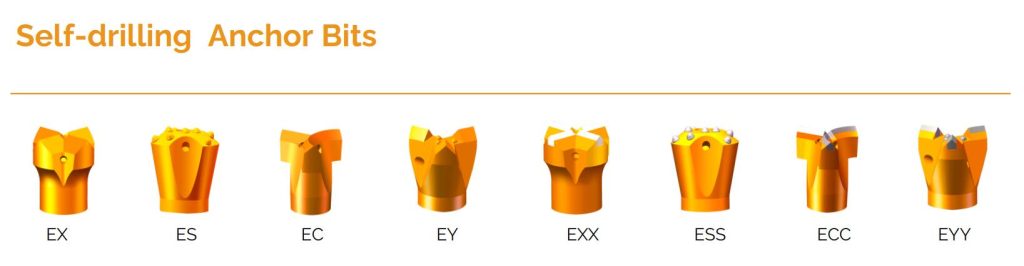
Self drilling anchor bits are widely used in tunneling, slope stabilization, foundation engineering, and mining projects. These bits are designed to drill and anchor in a single operation, improving efficiency and reducing installation time.
Different types, such as EX, ES, EC, EY, EXX, ESS, ECC, and EYY are developed for varying ground conditions and performance levels. Understanding each type helps ensure better drilling accuracy, longer tool life, and safer construction outcomes across different geological environments and project demands.
EX Type Self Drilling Anchor Bit
The EX type is designed as a standard heavy-duty option for general drilling applications. It provides balanced cutting performance and durability, making it suitable for medium-hard rock formations. It is commonly used in routine anchoring and foundation support works where extreme wear resistance is not required.
EX bits are valued for their cost efficiency and stable performance in everyday drilling tasks. They offer reliable penetration rates while maintaining structural strength under normal operating conditions. This makes them a popular choice for general construction and geotechnical projects.
ESS Type Self Drilling Anchor Bit
The ES type is optimized for softer to medium ground conditions. It delivers smooth drilling performance with reduced vibration, making it suitable for unstable or mixed soil layers. Its design focuses on efficiency rather than extreme hardness resistance.
ES bits are often used in projects where faster penetration is needed in less abrasive formations. They help improve productivity while maintaining consistent borehole quality, especially in civil engineering and shallow foundation applications.
EC Type Self Drilling Anchor Bit
The EC type is designed for enhanced cutting ability in medium-hard rock conditions. It provides improved wear resistance compared to basic models, making it suitable for more demanding geological environments. Its structure supports stable drilling under moderate stress.
EC drill bits are commonly used in slope reinforcement and underground excavation projects. They offer a good balance between durability and drilling speed, making them ideal for mixed rock formations.
EY Type Self Drilling Anchor Bit
The EY type is engineered for specialized drilling conditions where precision and stability are important. It performs well in variable ground formations where consistency is required across different layers. Its cutting structure helps maintain directional accuracy.
EY drill bits are often used in engineering projects requiring controlled drilling paths. They help reduce deviation and improve anchoring accuracy, making them suitable for complex geotechnical applications.
EXX Type Self Drilling Anchor Bit
The EXX type is a high-performance version designed for hard rock and long service life. It features reinforced cutting edges and improved wear resistance, making it suitable for extreme drilling environments. It is built for durability under high stress conditions.
EXX bits are widely used in mining, deep foundation work, and tough geological formations. They deliver longer lifespan and higher efficiency, reducing tool replacement frequency and overall project downtime.
ESS Type Self Drilling Anchor Bit
The ESS type is an upgraded version of Es, offering better strength and improved resistance to wear. It is designed for slightly more demanding soft to medium ground conditions where standard Es bits may wear faster.
ESS bits are used in projects that require higher productivity and longer tool life under similar soil conditions. They help maintain stable drilling performance while reducing maintenance and replacement costs.
ECC Type Self Drilling Anchor Bit
The ECC type is built for challenging medium-hard rock conditions with improved cutting efficiency. It provides stronger penetration capability and better resistance to abrasive formations compared to standard Ec bits.
ECC drill bits are commonly used in tunneling and infrastructure projects. They ensure consistent performance in tough environments, helping reduce drilling interruptions and improving overall operational stability.
EYY Self Drilling Anchor Bit
The EYY type is the most advanced variation in this series, designed for extremely complex and variable geological conditions. It offers enhanced control, stability, and wear resistance for high-demand applications.
EYY drill bits are typically used in deep excavation, mining, and high-risk geological zones. They deliver superior durability and precision, making them ideal for projects requiring maximum reliability and performance consistency.
| Type | Ground Condition | Key Feature | Typical Use |
|---|---|---|---|
| EX | Medium-Hard Rock | Balanced Performance | General Construction |
| ES | Soft To Medium Soil | Smooth Drilling | Shallow Foundations |
| EC | Medium-Hard Rock | Improved Cutting | Slope Reinforcement |
| EY | Variable Formations | High Precision | Controlled Drilling |
| EXX | Hard Rock | Maximum Durability | Mining And Deep Foundations |
| ESS | Soft To Medium Soil | Longer Life Than Es | Civil Engineering |
| ECC | Medium-Hard Rock | Stronger Penetration | Tunneling Projects |
| EYY | Complex Formations | Highest Stability | Advanced Geotechnical Works |
How to Choose Right Self Drilling Anchor Bits?
Selecting the right self-drilling anchor bits is important for achieving stable support, efficient penetration, and long service life in challenging ground conditions. Different formations demand different bit designs, and choosing correctly helps improve drilling speed, reduce tool wear, and maintain safety and performance in tunneling, mining, and foundation projects.
To make the best selection, it is necessary to evaluate ground hardness, bit geometry, flushing performance, and material strength. Each factor influences drilling efficiency and tool durability, ensuring the anchor system performs reliably under varying geological and operational conditions.
- Rock Hardness And Ground Conditions — Different geological formations require different cutting strengths to achieve efficient penetration. Softer soil needs sharper cutting edges, while hard rock requires reinforced carbide inserts. Matching the bit to ground conditions reduces vibration, improves drilling stability, and prevents premature wear, ensuring consistent performance and longer service life in demanding construction and mining environments.
- Bit Head Design And Shape — The shape of the drill bit head directly affects drilling speed, accuracy, and hole formation quality. Flat, domed, or ballistic designs are selected based on project requirements. Proper geometry enhances cutting efficiency, reduces resistance during drilling, and minimizes stress on the anchor system, leading to smoother operation and improved overall productivity.
- Flushing And Debris Removal Efficiency — Effective flushing channels are essential for removing cuttings from the borehole during drilling operations. Proper debris evacuation prevents clogging, reduces heat buildup, and maintains steady drilling speed. Whether using air or water flushing, the bit design must support smooth flow to ensure consistent performance and avoid unnecessary downtime in deep or long drilling applications.
- Material Quality And Wear Resistance — High-grade alloy steel combined with tungsten carbide inserts significantly improves durability and resistance to wear. Strong materials help the bit withstand high pressure, impact, and abrasive conditions. Choosing wear-resistant components extends tool lifespan, reduces replacement frequency, and ensures reliable drilling performance, especially in tough and abrasive geological environments.
Conclusion
EX and EXX drill bit markings help users identify performance levels, material strength, and suitable drilling applications. EX usually indicates standard reinforced capability, while EXX provides higher durability and extended wear resistance. Understanding these differences allows operators to choose the right bit for efficiency, cost savings, and consistent drilling performance in various ground conditions and industrial environments with ease.
Selecting between EX and EXX drill bits depends on project requirements, rock hardness, and expected drilling lifespan. Proper selection reduces downtime, improves penetration rates, and enhances overall safety. Contractors should always evaluate ground conditions and tool specifications before choosing the appropriate bit type for optimal results in both small-scale and large-scale drilling projects effectively for maximum efficiency and performance consistently.
Understanding EX and EXX drill bit differences helps improve drilling efficiency, reduce equipment wear, and ensure better project outcomes across construction and mining applications. We supply wholesale self drilling anchor bits from our Sinodrills, designed for high strength, reliability, and long service life in demanding drilling environments. Choose quality tools to achieve safer, faster, and more efficient drilling results consistently.