
Self drilling anchor systems are advanced anchoring systems, composed of high-strength fully threaded self-drilling anchor bars, anchor bits, anchor couplers, anchor nuts, anchor plates, and other necessary components. These systems can simultaneously execute drilling and grouting functions in loose soil and fractured rock.
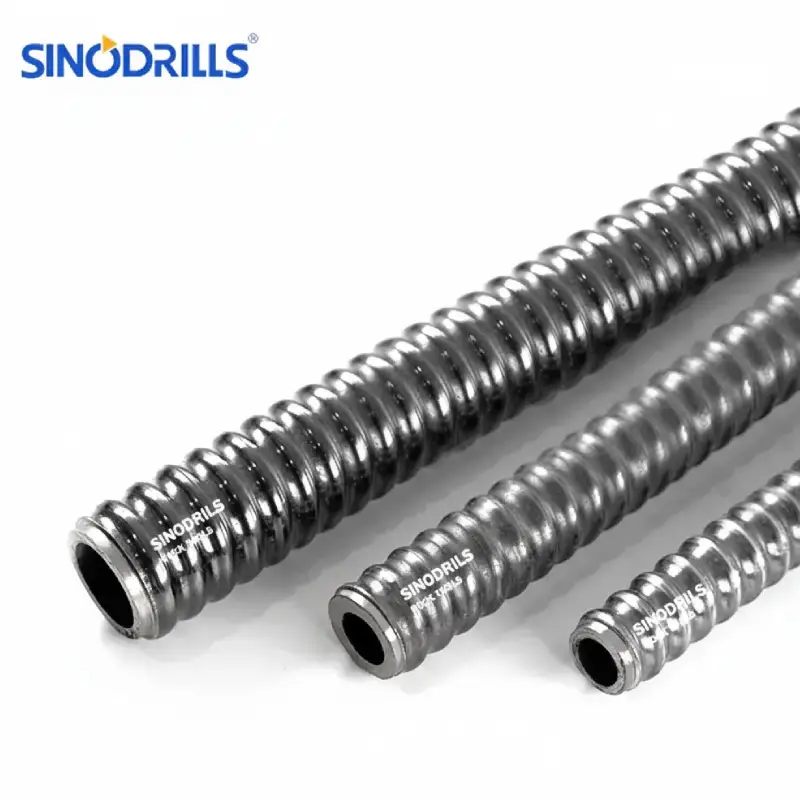
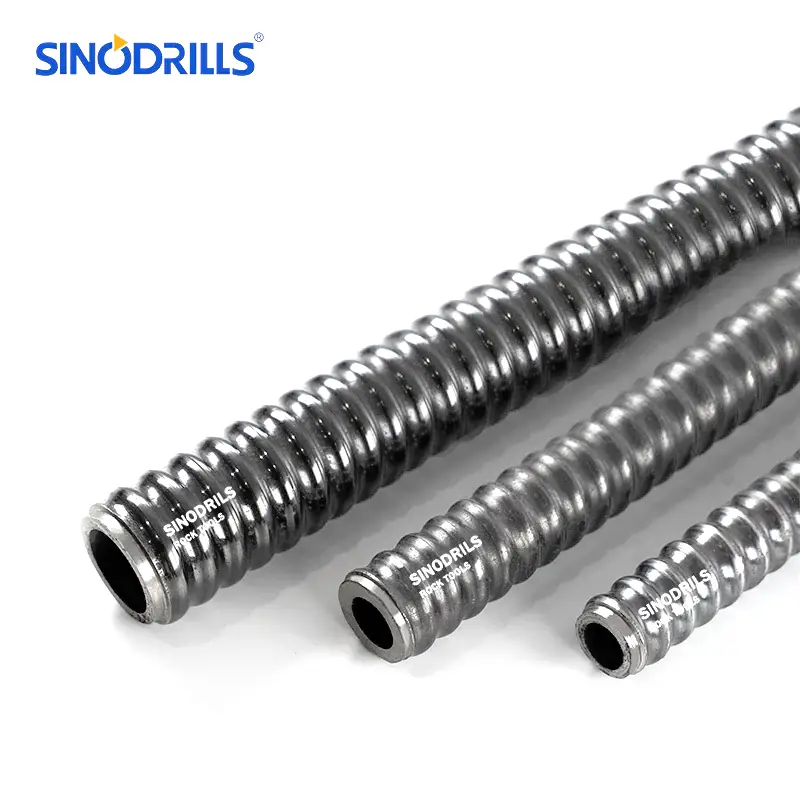
The crucial component of the self-drilling anchoring system is the self drilling anchor bars, which is divided into R thread and T thread. R-type threads feature continuous corrugated profiles, typically designed according to ISO 10208 or ISO 1720 standards, with common sizes being R25, R32, R38, R51, etc. T-type threads are usually based on internal designs of each manufacturer and do not conform to any international standard, with common sizes including T30, T40, T52, T73, T76, T103, T111, etc.
What are Self Drilling Anchor Bars?
Self drilling anchor bars are steel anchoring systems designed to drill, grout, and anchor in one continuous operation. They combine a hollow threaded bar with a drill bit, allowing installation in unstable ground conditions.
Grout is injected through the bar during drilling, creating immediate support for tunneling, mining, slope stabilization, and foundation reinforcement projects.
Recommended Self Drilling Anchor Bars
Self Drilling Anchor Bar Production Method
Self drilling anchor bar production follows a controlled manufacturing process to ensure strength, accuracy, and durability for ground support applications. It starts with selecting high-grade alloy steel, followed by hot rolling to form the bar profile.
Precision machining creates continuous threads, while heat treatment improves mechanical performance. Final steps include surface treatment, inspection, and testing to meet engineering standards.
There are 3 ways to produce self -drilling anchor bars: cold rolling, hot rolling, and warm rolling.
1. Cold Rolling
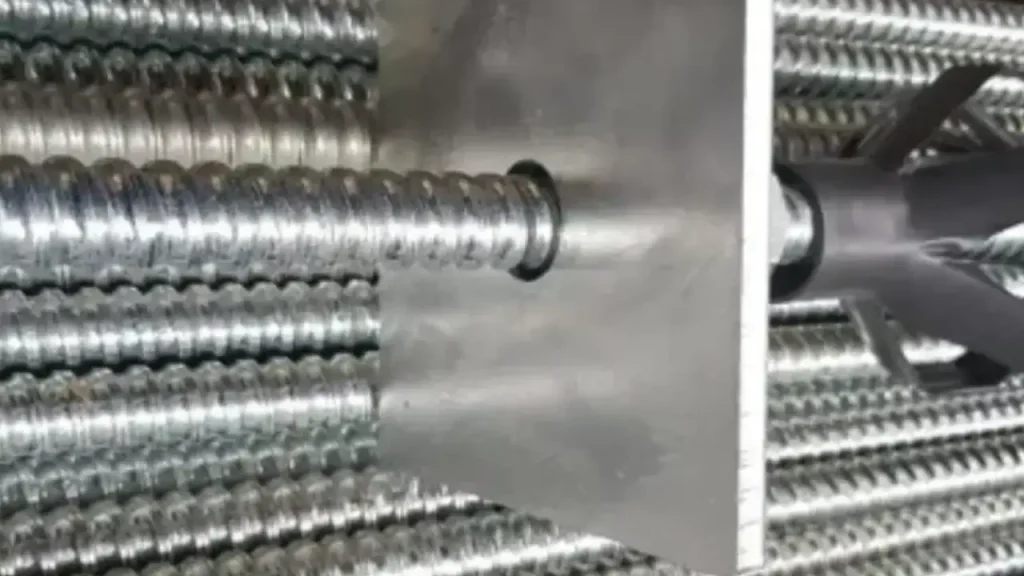
Widely used in European countries, this process employs low-carbon alloy steel pipes as raw material. Low-carbon alloy steel pipes inherently has lower hardness and strength but better plasticity, allowing it to be rolled at room temperature without heating. This rolling process refines the grain structure. As heating is not required, this method is more energy-efficient and environmentally friendly, and the quality is relatively stable.
However, since it does not undergo heat treatment, the strength of the self-drilling anchor bars primarily depends on the strength of the steel pipes. To achieve adequate load capacity (mainly tensile and yield strength), these self-drilling anchor bars must maintain sufficient thickness, meaning a relatively heavier weight per meter or larger section area.
2. Hot Rolling
Evolving from cold rolling process, hot rolling is mainly used in countries like China, Turkey, Iran, and India. The self-drilling anchor bars formed by hot rolling generally use medium-carbon alloy steel pipes. Unlike cold rolling, hot rolling requires the raw material to be heated above the phase transition temperature (around 1000℃) before rolling, followed by rapid water cooling, essentially an incomplete quenching process.
While this method enables the production of stronger self-drilling anchor bars with thinner steel tubes, it compromises the ductility of the self-drilling anchor bars. The self-drilling bars are stronger but less plastic and more brittle with a lower elongation rate.
Furthermore, the equipment used in this process is often primitive, and due to large temperature variances in the environment, it’s challenging to control the exact temperature changes, leading to inconsistent dimensions and quality of the self-drilling anchor bars. If the quality requirement for self-drilling anchor bars is not high,, hot rolling can be economically beneficial for use in temporary support project, but is unsuitable for permanent project.
3. Warm Rolling
Warm rolling is an intermediary process between cold and hot rolling, usually also utilizing medium-carbon steel pipe as the raw material. This method requires heating the raw material to about 500℃ for rolling. It optimizes the properties of the steel pipe, balancing and ensuring strength while also achieving good ductility of the self-drilling anchor bars.
Additionally, as the heating temperature is not very high, the dimensional control of the self-drilling anchor bars is more precise, and the quality is stable. Thus, warm rolling allows for an excellent balance between the toughness and ductility of self-drilling anchor bars, achieving superior overall mechanical properties.
Anchor Bars Manufacturing Process
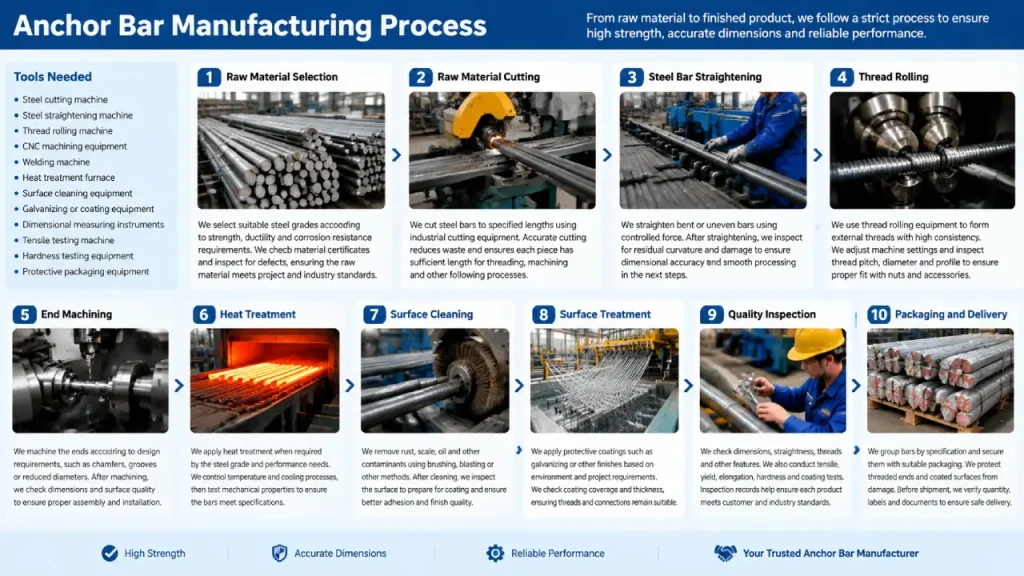
Anchor bars are essential components in construction, mining, tunneling, and ground stabilization projects. Their manufacturing process involves several carefully controlled stages to ensure strength, dimensional accuracy, and reliable performance under demanding conditions.
Understanding each step helps buyers evaluate product quality, material selection, production efficiency, and the suitability of anchor bars for specific engineering applications.
Tools Needed
- Steel cutting machine
- Steel straightening machine
- Thread rolling machine
- CNC machining equipment
- Welding machine
- Heat treatment furnace
- Surface cleaning equipment
- Galvanizing or coating equipment
- Dimensional measuring instruments
- Tensile testing machine
- Hardness testing equipment
- Protective packaging equipment
Step 1: Raw Material Selection
We select suitable steel grades according to the required tensile strength, yield strength, ductility, and corrosion resistance of the finished anchor bars. Material selection depends on project specifications, installation environments, and applicable industry standards. We review material certificates to confirm chemical composition and mechanical properties before production begins.
We also evaluate steel bar diameters, surface conditions, and material consistency before accepting incoming supplies. Our quality team checks for visible defects, excessive rust, cracks, and dimensional variations that could affect subsequent processing. Proper material selection establishes a reliable foundation for producing anchor bars that meet customer requirements and engineering expectations.
Step 2: Raw Material Cutting
We cut steel bars into specified lengths using suitable industrial cutting equipment. Cutting dimensions are determined by engineering drawings, installation requirements, and the intended application. Accurate cutting helps minimize material waste and ensures each workpiece has sufficient length for subsequent machining, threading, and other required manufacturing operations.
During this stage, we monitor cutting accuracy and inspect the resulting ends for excessive burrs, deformation, or irregular surfaces. Consistent cutting improves production efficiency and reduces unnecessary rework. We organize the cut steel pieces by size, specification, and production batch to maintain traceability throughout the manufacturing process.
Step 3: Steel Bar Straightening
We straighten steel bars when incoming materials contain bends or dimensional deviations that could affect machining accuracy. Suitable straightening equipment applies controlled force to correct unwanted curvature while maintaining the required material integrity. Proper alignment helps ensure that anchor bars meet dimensional specifications and remain suitable for subsequent processing operations.
After straightening, we inspect each workpiece for residual curvature, surface damage, and other visible defects. We use appropriate measuring instruments to verify straightness against applicable tolerances. This inspection helps prevent alignment problems during threading, machining, and assembly, supporting consistent product quality and reliable installation performance across different anchor bar applications.
Step 4: Thread Rolling
We use thread rolling equipment to form external threads on compatible anchor bar designs. The process deforms the steel surface under controlled pressure rather than removing material through conventional cutting. Depending on the product specification, thread rolling can produce consistent thread profiles and improve surface characteristics for suitable steel grades.
Our production team adjusts rolling dies, machine settings, and thread dimensions according to engineering drawings. We inspect thread pitch, diameter, profile, and engagement compatibility using appropriate gauges. Accurate thread formation helps ensure anchor bars connect properly with nuts, couplers, plates, and other accessories used in ground support and structural anchoring systems.
Step 5: End Machining
We machine the ends of anchor bars when specific designs require chamfers, reduced diameters, grooves, or other connection features. CNC machining or conventional equipment can produce these details according to approved drawings. Accurate end preparation supports proper component fit, facilitates installation, and helps prevent interference during assembly with compatible anchoring accessories.
After machining, we inspect the finished ends for dimensional accuracy, surface defects, and unwanted burrs. Our team verifies that each feature matches the required specifications and does not compromise the intended connection. Proper end machining improves assembly consistency and helps ensure the anchor bars perform as expected within their designated applications.
Step 6: Heat Treatment
We apply heat treatment when required by the specified steel grade and mechanical performance requirements. Controlled heating and cooling processes can adjust steel strength, hardness, and toughness. The selected treatment depends on material composition, bar dimensions, manufacturing methods, and the mechanical properties required for the intended anchoring application.
During heat treatment, we monitor relevant process parameters to maintain consistency between production batches. After treatment, we conduct appropriate mechanical tests to verify that the bars meet specified requirements. Not every anchor bar requires heat treatment, so we select the process according to the approved product design and applicable manufacturing standards.
Step 7: Surface Cleaning
We clean anchor bar surfaces to remove loose rust, scale, oil, and other contaminants that may interfere with inspection or subsequent coating operations. Depending on material condition and the required finish, we use mechanical brushing, abrasive blasting, or other suitable industrial cleaning methods to prepare the steel surface.
After cleaning, we inspect the bars for remaining contaminants, surface imperfections, and signs of corrosion. Proper preparation helps improve coating adhesion when protective treatments are required. We also ensure that cleaning methods are compatible with the steel grade and finished dimensions, maintaining product integrity before the next manufacturing stage begins.
Step 8: Surface Treatment
We apply suitable surface protection when anchor bars require additional resistance to corrosion or environmental exposure. Depending on customer specifications, available treatments may include hot-dip galvanizing, protective coatings, or other approved finishes. The selected method depends on the installation environment, service life expectations, dimensional requirements, and applicable project standards.
After treatment, we inspect coating coverage, surface consistency, and relevant thickness requirements where applicable. We also verify that threads and connection features remain suitable for assembly. Because coating processes can affect dimensions and compatibility, we select appropriate treatments and inspection criteria for each anchor bar specification and its intended operating conditions.
Step 9: Quality Inspection
We inspect finished anchor bars to confirm compliance with approved drawings, technical specifications, and applicable standards. Dimensional checks cover bar length, diameter, straightness, thread geometry, and other required features. Depending on the product, our quality control procedures may also include tensile testing, yield strength verification, elongation testing, hardness measurement, and coating inspection.
We record inspection results and identify products that do not meet acceptance criteria. Where necessary, we investigate deviations and determine whether corrective action or rejection is appropriate. Consistent quality inspection helps ensure that delivered anchor bars satisfy customer requirements and provide dependable performance in construction, mining, tunneling, and ground stabilization projects.
Step 10: Packaging and Delivery
We prepare accepted anchor bars for shipment according to their dimensions, surface finishes, and transportation requirements. Bars are grouped by specification and secured with suitable strapping, protective materials, or other packaging methods. We protect threaded ends and coated surfaces against impact, contamination, and handling damage during storage and transportation.
Before dispatch, we verify product quantities, identification labels, packaging condition, and accompanying documentation. We coordinate shipment arrangements according to the customer’s delivery schedule and destination requirements. Proper packaging and clear identification help maintain product condition, simplify receiving inspections, and ensure anchor bars arrive ready for the customer’s planned construction or mining operations.
Conclusion
As a professional manufacturer with over 20 years of production experience, Sinodrills possesses 8 full automated self-drilling anchor bars production lines. Our self-drilling anchor bars are dimensionally precise and consistent, ensuring strength and excellent toughness, fully reaching
European standards, in some aspects even exceeding European standards. Our products are now widely used in railway, tunnel, rock bolting, infrastructure, and mining projects across Europe!
Anchor down your next project with Sinodrills’self -drilling anchor systems!