
Rock bit tooth shapes play a crucial role in drilling performance across different geological formations. The design of each tooth determines how effectively the bit cuts, crushes, and removes rock. Understanding these variations helps operators improve efficiency, reduce wear, and achieve more stable drilling results in challenging environments today globally.
Different tooth structures such as chisel, conical, and spherical designs are engineered for specific rock conditions. Soft formations require faster cutting action, while hard rock demands stronger impact resistance. Selecting the right tooth shape ensures better penetration rates, longer tool life, and improved overall drilling productivity in field operations today.
What is a Rock Bit Tooth?
A rock bit tooth is the cutting element on a drill bit that directly contacts and breaks rock during drilling operations. Its shape, material, and arrangement determine how efficiently the bit penetrates different formations.
Designed for durability and impact resistance, rock bit teeth help crush, scrape, or shear rock, making them essential for effective drilling performance in various geological conditions.
Rock Bit Tooth Shapes
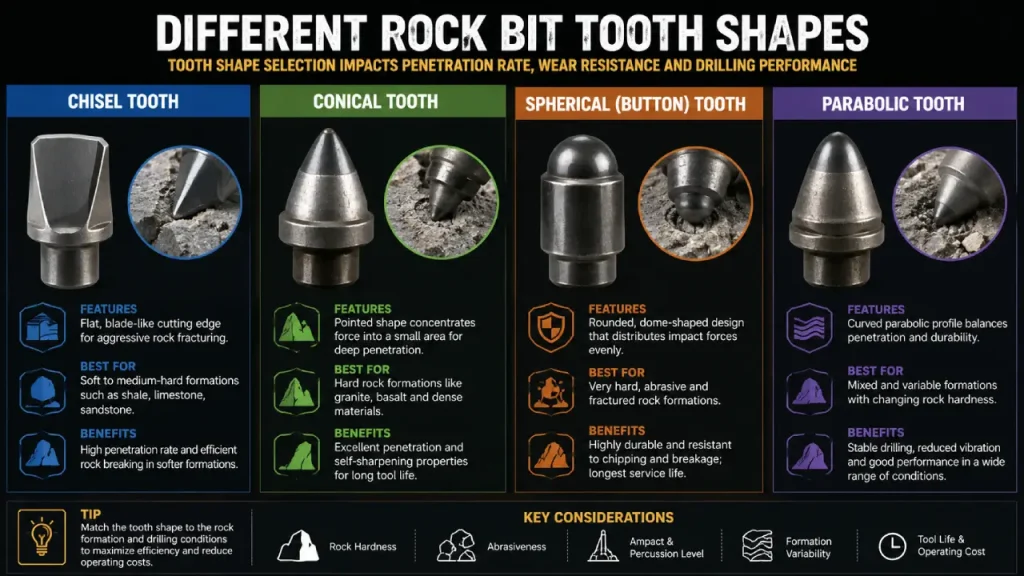
Rock bit tooth shapes determine drilling efficiency, penetration rate, and wear resistance in different geological formations. Each design is engineered to balance cutting speed, durability, and stability under high impact conditions.
Understanding these shapes helps operators choose the right bit for hard or soft rock drilling applications, improving performance and reducing tool costs over time in mining, tunneling, and construction projects worldwide for optimal results in demanding environments consistently reliable.
Chisel Tooth Shape
Chisel teeth feature a flat, blade-like cutting edge designed for aggressive rock fracturing. They are commonly used in softer to medium-hard formations where rapid penetration is more important than extreme wear resistance. Their broad contact area helps break rock efficiently while maintaining steady drilling performance.
These teeth are especially effective in sedimentary rock layers, where controlled cutting action reduces bit bounce. However, in very hard formations, they may wear faster due to higher impact stress on the cutting edge.
Conical Tooth Shape
Conical teeth are pointed and concentrate force into a small contact area, allowing deeper penetration into hard rock formations. This shape improves crushing efficiency by applying high stress at a single point, making it suitable for granite and other dense materials.
They also offer good self-sharpening properties as wear gradually maintains a sharp profile. This makes them popular in demanding drilling environments where long-term durability and consistent performance are essential.
Spherical (Button) Tooth Shape
Spherical or button teeth are rounded and highly durable, designed to withstand extreme impact and abrasion. They distribute drilling forces evenly, reducing the risk of chipping or breakage in very hard and fractured rock formations.
Because of their toughness, they are widely used in mining and tunneling operations. While they may penetrate more slowly than sharper designs, their longevity significantly reduces downtime and replacement costs.
Parabolic Tooth Shape
Parabolic teeth combine features of both conical and spherical designs, offering a balanced approach between penetration and durability. Their curved profile helps maintain cutting efficiency while reducing stress concentration on the tooth surface.
This shape performs well in mixed formations where rock hardness varies. It provides stable drilling action, minimizing vibration and improving overall control during long drilling operations.
How to Choose Rock Bit Tooth Shapes for Optimal Drilling?
Choosing the right rock bit tooth shape is essential for achieving efficient drilling, longer tool life, and reduced operational costs. Different geological formations require different cutting structures to maintain penetration speed and stability.
Understanding how each tooth design performs helps operators match the bit to the rock conditions for optimal results ensuring consistent performance in varying environments and efficiency gains.
- Soft formations: Soft formations such as clay, shale, or soft limestone require rock bits with sharper and more aggressive tooth shapes. These designs improve cutting speed and prevent clogging. They allow faster penetration while minimizing energy use, making drilling operations smoother and more efficient in low-resistance geological conditions.
- Medium formations: Medium formations such as sandstone and limestone require balanced tooth shapes that combine durability and cutting efficiency. These bits provide stable penetration rates and moderate wear resistance. They are ideal for general drilling applications where neither extreme hardness nor extreme softness dominates the formation characteristics.
- Hard formations: Hard formations like granite and basalt require durable rock bits with strong reinforced tooth shapes designed for impact resistance. These bits prioritize strength over speed, reducing wear under high-pressure conditions. They ensure controlled penetration and extended tool life in challenging deep drilling environments.
- Abrasive formations: Abrasive formations containing quartz or other hard minerals require wear-resistant tooth shapes with protective coatings. These bits reduce erosion and maintain cutting efficiency over time. They are essential for maintaining performance in highly abrasive environments where standard bits would degrade quickly under continuous operation conditions.
Conclusion
Understanding rock bit tooth shapes helps drilling professionals optimize performance across varying geological formations. Proper selection reduces operational costs, improves drilling speed, and extends equipment lifespan. Each tooth design serves a specific purpose, making informed choices essential for successful outcomes in both soft and hard rock drilling environments worldwide ensuring reliability and efficiency in demanding projects every time consistently used.
Different geological conditions require careful evaluation of rock bit tooth shapes to ensure optimal drilling performance. Matching tooth geometry with rock hardness improves penetration efficiency and reduces unnecessary wear. Engineers and operators benefit from selecting suitable bit designs that enhance stability, minimize downtime, and deliver consistent results across diverse drilling applications in real world operations daily use field performance testing.
Choosing the right rock bit tooth shapes is essential for maximizing drilling efficiency and ensuring long term tool performance. With proper knowledge of cutting structures, operators can reduce costs and improve project success rates. Investing in the right equipment supports safer and more productive drilling operations across industries get wholesale rock drill bits from our Sinodrills today for best results.