
The stabilization of slopes and excavations is a key concern in all construction projects. Geotechnical engineers must select the best earth retention system for each unique site. The choice is often between a conventional retaining wall, a heavy and rigid structure, and the flexible, in-situ method of soil nailing. We explore the distinct principles, advantages, and limitations of these two common solutions.
Understanding these differences is crucial for project success, ensuring we select the most efficient and safe technique. We must consider factors like soil conditions, space constraints, and project duration to make an informed decision. Soil nailing reinforces the soil from within, while a retaining wall relies on mass and structure.
What is Soil Nailing?
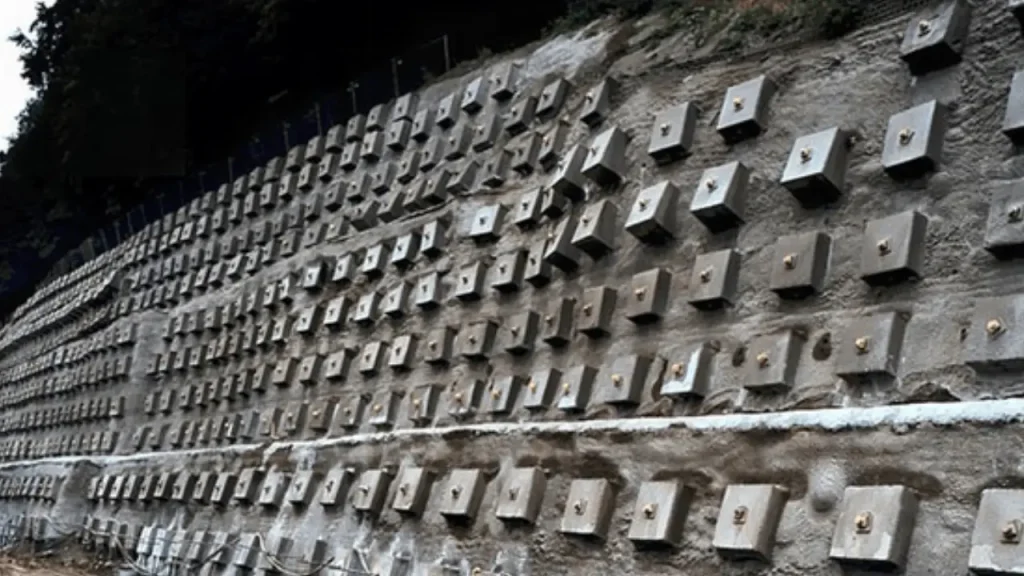
Soil nailing is a proven construction technique we use to reinforce and stabilize existing slopes or deep excavations. This method involves inserting slender, tension-resisting steel bars, or nails, into the ground and securing them in place. This creates a reinforced soil mass that acts like a composite gravity structure, enhancing shear strength and stability.
This top-down process is often a cost-effective and flexible alternative to traditional retaining walls, especially in confined or difficult-to-access sites. We rely on the internal reinforcement of the soil to resist movement.
- Internal Reinforcement System This technique involves installing closely spaced steel bars into pre-drilled holes in the soil, typically at a slight downward angle. We use grout to permanently bond the nails to the surrounding soil, activating their tensile capacity to resist the outward movement of the soil mass.
- Top-Down Construction Method The process begins by excavating a small vertical cut. We then drill and install the first row of soil nails, apply a temporary or permanent facing like shotcrete, and then repeat the process on the next layer of excavation.
- Composite Soil Structure Once the nails are installed and grouted, they work together with the native soil to form a unified, reinforced block. This composite material increases the overall stability and shear resistance of the slope, effectively preventing collapses or landslides.
- Facing and Drainage We apply a reinforced layer, usually shotcrete or mesh, to the exposed soil face. This facing prevents surface erosion and helps to distribute the load from the nails evenly across the surface, providing additional structural support.
What are Retaining Walls?

A retaining wall is a rigid, engineered structure we design to laterally support soil and maintain the ground at different elevations. This structure prevents the mass of earth on a slope from collapsing or eroding away due to gravity, effectively holding it in place. We construct these walls using materials like concrete, stone, masonry, or specialized blocks, and they are essential in civil engineering and landscaping.
Retaining walls are crucial for maximizing usable space on sloped terrain, creating level areas for roads, buildings, and gardens. They must be carefully engineered to resist the lateral earth pressure exerted by the retained soil, ensuring structural stability against sliding and overturning forces.
- Gravity Retaining WallsThese structures are the most fundamental type, relying on their own immense weight and mass to counteract the pressure of the soil they hold back. They are typically massive and constructed from materials like concrete, stone, or precast modular blocks, and are best suited for walls of lower to moderate height.
- Cantilever Retaining WallsWe construct these walls using steel-reinforced concrete in an inverted $\text{T}$ or $\text{L}$ shape. The base slab extends into the retained soil, using the weight of the soil on the heel to provide stability and leverage to resist the large horizontal forces, making them efficient for taller installations.
- Sheet Pile Retaining WallsThese walls are formed by driving thin sheets of material, often interlocking steel, deep into the ground. We use this type primarily in soft soils and confined spaces, such as near waterfronts or for temporary excavations, where they rely on their embedment depth for stability.
- Anchored Retaining WallsAn anchored wall is any type of retaining wall that incorporates additional support from anchors or tiebacks embedded into the stable soil or rock mass behind the wall. This system allows us to build thinner or lighter walls and is particularly useful for very tall walls or in conditions with high lateral pressure.
Soil Nailing vs Retaining Walls

The decision between using soil nailing or a traditional retaining wall is fundamental in geotechnical engineering for earth retention. While both systems stabilize slopes and support excavations, their operational mechanisms, construction processes, and suitable applications are distinctly different. We must understand these contrasts to select the most efficient and economical solution for a project’s specific site conditions.
Mechanism of Stabilization
Soil nailing is an in-situ reinforcement technique where we insert closely spaced steel bars into the existing soil mass. This technique creates a composite block of soil and reinforcement that is strengthened internally, making it a passive system that relies on ground movement to mobilize resistance. We provide a solution that integrates with the surrounding earth.
A retaining wall, conversely, is a massive, external barrier that resists lateral earth pressure primarily through its own weight or structural rigidity. Gravity walls use their mass, while cantilever and anchored walls use structural leverage and tiebacks. We design these walls as distinct, heavy structures built to hold the soil back.
Construction Method and Sequencing
The installation of a soil nail wall is a top-down process, meaning we excavate a small lift, install a row of nails, apply a shotcrete face, and then repeat this sequence for the next layer. This method allows for fast construction and minimal excavation volume, and it requires relatively small and agile equipment, making it ideal for confined sites.
In contrast, traditional retaining walls are often a bottom-up construction process. This requires extensive, deep excavation to construct the wall’s large foundation or base first. The construction typically requires heavy machinery and significant workspace for materials and equipment, which can lead to more site disruption and longer build times.
Space and Site Constraints
Soil nailing excels in projects with limited right-of-way or space constraints, such as urban areas or narrow roadway cuts. The small equipment footprint and the minimal need for deep, open excavation mean we can install the system without significantly impacting adjacent structures or existing infrastructure.
Retaining walls, particularly gravity and cantilever types, demand ample space for their wide base slabs and for the machinery necessary to construct them. The need for a large, clear work area for deep foundation work and material storage makes them less suitable for sites where space is severely restricted.
Cost-Effectiveness and Speed
We often find soil nailing to be a more cost-effective and faster solution than conventional retaining walls, especially for deep excavations or temporary support. The system uses less material, utilizes the existing soil, and the top-down sequence contributes to a quicker overall construction schedule and reduced labor costs.
Retaining walls, especially tall, reinforced concrete structures, typically have a higher material cost due to the volume of concrete, rebar, and specialized backfill required. The complexity of the foundation work and the sheer mass of the structure generally translate into a longer construction time and a greater overall expense.
Soil and Water Suitability
Soil nailing performs best in soils that can stand unsupported for a short period, possessing a reasonable degree of apparent cohesion. It is generally not as effective in highly permeable, cohesionless soils, or sites with high groundwater tables, as excessive water flow can compromise the temporary excavation face and grout bond.
Retaining walls can be designed to be highly effective across a wider variety of soil types, including those with poor strength or high water content. With proper design, including robust foundation systems and comprehensive drainage features, we can ensure stability even in very challenging geotechnical environments.
| Aspect | Soil Nailing | Retaining Walls |
| Primary Mechanism | Internal reinforcement (Passive system) | External resistance (Mass or structure) |
| Construction Method | Top-down, progressive excavation | Bottom-up, foundation first |
| Space Requirement | Minimal footprint, ideal for confined sites | Requires large footprint for base and work area |
| Cost & Speed | Often more economical and faster to install | Generally higher material cost and longer construction time |
| Soil Suitability | Requires cohesive soil; sensitive to high groundwater | Adaptable to wider range of soil types with proper design |
How to Choose Soil Nailing and Retaining Walls?
The selection between a soil nail system and a conventional retaining wall is a critical geotechnical decision that hinges on balancing site-specific constraints, long-term performance needs, and project budget. We must evaluate several key factors to determine which earth retention technique provides the most efficient, safe, and cost-effective solution for stabilizing slopes or supporting excavations. The right choice prevents failure and ensures project success.
We approach this choice by first conducting a thorough geotechnical investigation to understand the subsurface conditions and project demands. This analysis guides us toward the system that best leverages the existing ground’s properties while addressing limitations such as groundwater, adjacent structures, and space availability.
- Project Duration and Permanence: If we require a temporary excavation support, such as shoring for a basement construction, soil nailing is often the preferred, adaptable option due to its speed and removal ease. For permanent installations that must withstand long-term loads and weather, a durable retaining wall might be the more traditional and visually appealing structural choice.
- Soil Suitability and Groundwater: Soil nailing performs optimally in cohesive soils that can stand unsupported for a short period during excavation. We generally avoid soil nailing in loose, cohesionless sands or areas with a high water table, as water flow can compromise the bond. Retaining walls, with their structural foundation, are more suitable for weaker or waterlogged soils.
- Space Constraints and Access: For sites with limited space, like urban excavations adjacent to existing buildings, we select soil nailing. The small-scale equipment and top-down construction sequence require minimal working space behind the wall face. Retaining walls, especially gravity types, demand a significant footprint for their base and construction activities.
- Structural Movement Tolerance: Soil nailing is a passive system, meaning a small, acceptable amount of soil movement is needed to fully mobilize the tensile resistance in the nails. If the project is extremely sensitive to movement, such as one next to a bridge abutment or a fragile structure, we may choose a more rigid retaining wall system, often anchored, to limit deformation.
- Aesthetics and Finishing: For projects where the exposed face must be architecturally appealing, a retaining wall offers diverse finishing options like stone veneer or decorative concrete. While we can finish soil nail walls with decorative shotcrete, their final appearance is often more utilitarian, which may be a deciding factor in certain landscape designs.
Conclusion
Choosing the right earth retention system, whether a traditional retaining wall or a modern soil nail wall, is critical for achieving long-term stability. We have seen that retaining walls serve as massive external barriers, using their own weight and material strength to hold back soil. Conversely, soil nailing creates a reinforced composite soil mass by inserting and grouting steel tendons, offering a flexible and adaptable solution.
Soil nailing is often the preferred choice for tight spaces, uneven terrain, and projects requiring a faster, top-down construction approach. We provide a solution that is both cost-effective and minimally disruptive, creating an integrated block of stabilized earth. We provide reliable self drilling anchor systems for this modern stabilization technique.
For your next project requiring rapid installation and maximum performance in challenging soil, we supply dependable self drilling anchor systems. These anchors combine drilling and grouting into one step, significantly increasing installation efficiency and bond strength. Get wholesale self drilling anchor from our Sinodrills to ensure we provide structural integrity and unwavering safety for your entire project.