
Casing While Drilling (CWD) has become a truly transformative technology, providing a streamlined, integrated approach that addresses many traditional drilling challenges head-on. This innovative approach allows us to run casing while drilling, effectively integrating two distinct operations into one seamless process.
This blog post will delve into the core benefits of Casing While Drilling, explore specific applications where it really excels, and look to the future of this transformative technology while working to improve overall well construction efficiency and safety.
What is Casing While Drilling?
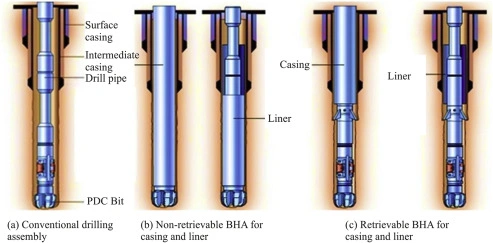
Casing While Drilling (CWD) is an innovative well construction technique where the casing string itself functions as the drill string. This means that instead of performing drilling and casing operations as separate, sequential steps, they are integrated and executed simultaneously.
A drill bit is attached directly to the casing shoe, or a retrievable bottom-hole assembly (BHA) drills ahead, while drilling fluid circulates through the casing and returns via the annulus. This method fundamentally streamlines the well construction process, aiming to enhance efficiency, improve wellbore stability, and reduce overall drilling time and costs.
How Does CWD Work?
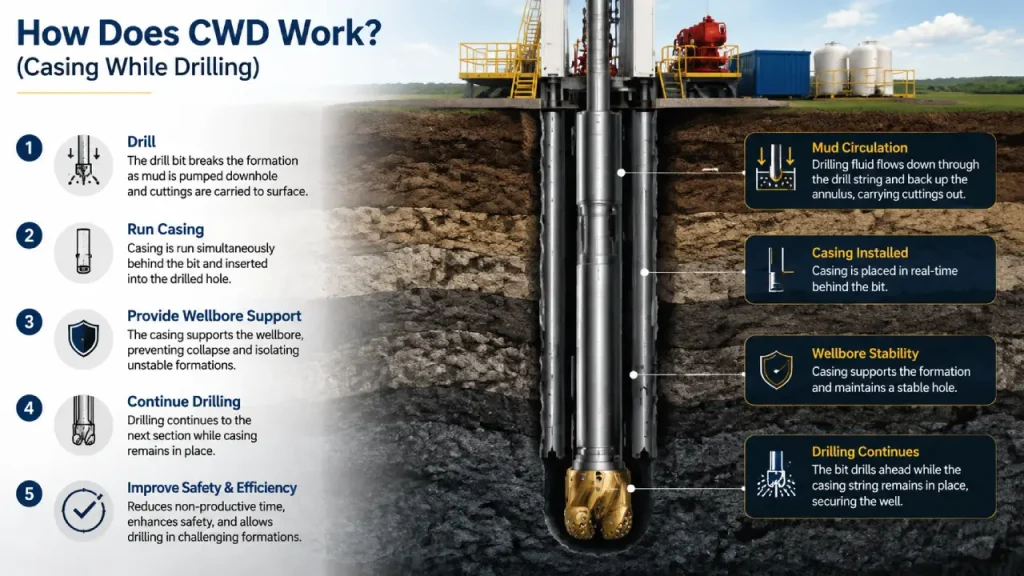
Casing While Drilling (CWD) is an advanced drilling technique where the casing is installed at the same time as the borehole is being drilled. This method improves wellbore stability, reduces the risk of collapse, and increases efficiency in challenging geological formations.
Instead of drilling first and casing later, both processes happen together, which saves time and enhances safety.
- Drill Phase: The drill bit breaks the rock formation while drilling fluid is pumped down the wellbore. This fluid carries cuttings back to the surface and keeps the hole clean and stable throughout the operation.
- Run Casing: The casing is simultaneously run behind the drill bit, lining the wellbore as drilling progresses deeper into the formation in real time.
- Wellbore Support: The casing reinforces the wellbore walls, preventing collapse and isolating unstable or fractured geological zones during drilling.
- Continue Drilling: The drill bit continues advancing while the casing remains in place, ensuring uninterrupted drilling operations and maintaining hole integrity.
- Improve Safety & Efficiency: This integrated process reduces non-productive time, enhances operational safety, and makes drilling more effective in difficult formations.
Overall, CWD combines drilling and casing into a single continuous operation, making it a highly efficient solution for modern drilling projects where stability and speed are critical.
Types of Casing While Drilling
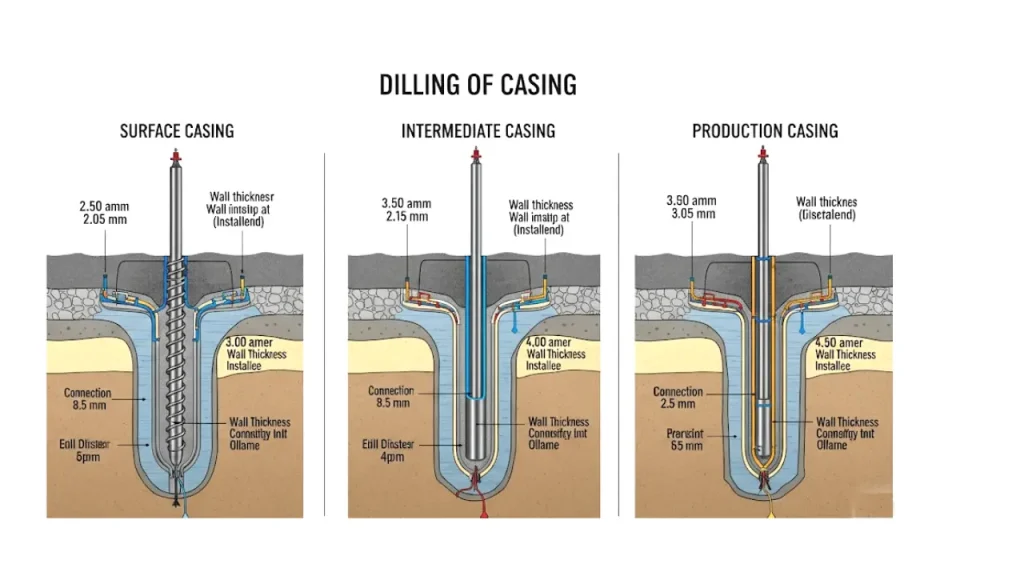
Casing while drilling is a technique that simultaneously drills and cases the well, offering significant time and cost savings. Here are the general types of casing used in drilling operations
Surface Casing
Surface Casing is typically the first and largest diameter casing string set in a well using the Casing While Drilling (CwD) method. Its primary purpose is to seal off shallow, unconsolidated formations and protect freshwater aquifers from contamination by drilling fluids. As depicted, it’s drilled into the upper part of the wellbore, often through loose soil or gravel, and then cemented in place. This provides a stable foundation for subsequent drilling operations and prevents the upper sections of the hole from caving in. The CwD technique is particularly effective here, as it minimizes the open-hole time in these unstable zones, enhancing safety and efficiency from the very beginning of well construction.
Intermediate Casing
Intermediate Casing is run after the surface casing and extends deeper into the wellbore. Its main function in Casing While Drilling is to isolate troublesome zones, such as formations with abnormal pressures, lost circulation zones, or volatile rock. By drilling and casing simultaneously, we can quickly seal off these problematic intervals, preventing further complications and improving wellbore integrity.
This allows for the use of different drilling fluid weights in deeper sections without impacting shallower, weaker formations. The image illustrates how this casing string effectively bridges the gap between the surface and the deeper, more challenging geological layers, ensuring a secure path for continued drilling.
Production Casing
Production Casing is the final casing string installed in a well using Casing While Drilling, extending from the surface or a previous casing point down to the target hydrocarbon reservoir. Its critical role is to isolate the productive zones, ensuring that hydrocarbons can be safely and efficiently produced without intermingling with other formation fluids or contaminating the environment.
The CwD method allows for a continuous drilling and casing process right into the reservoir, which can be beneficial in maintaining wellbore stability in complex or depleted pay zones. Once set and cemented, this casing provides the conduit for hydrocarbon flow and supports the well completion equipment, forming the backbone of the producing well.
What Are the Benefits of Casing While Drilling?
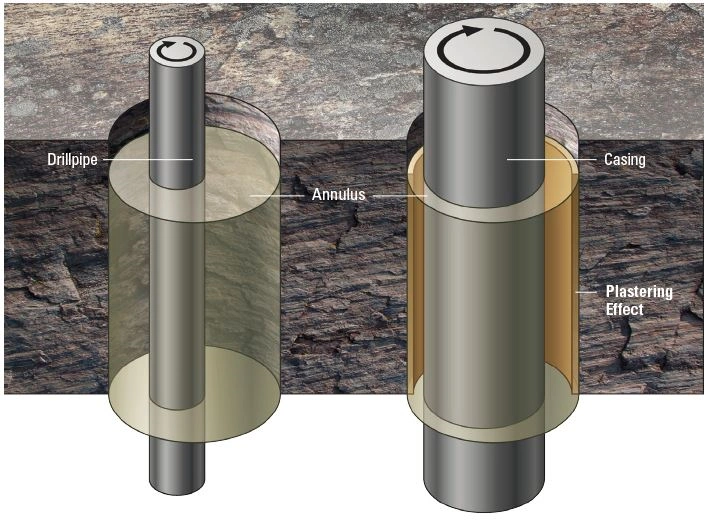
Casing While Drilling (CWD) is an advanced technique that revolutionizes well construction by running the casing into the borehole simultaneously with the drilling process. This integrated approach fundamentally improves wellbore stability, safety, and operational efficiency, making it an indispensable method for drilling in challenging, unstable formations.
The significant benefits of Casing While Drilling include:
- Improved Wellbore Stability: The immediate placement and rotation of the casing string reinforces the borehole wall as soon as it is drilled. This continuous support, combined with a ‘plastering effect’ from the casing, seals weak, fractured, or unconsolidated zones, virtually eliminating the risk of hole collapse or sloughing shale.
- Significant Time and Cost Reduction: By eliminating the conventional step of tripping the drill string out to run the casing separately, CWD drastically cuts down non-productive time (NPT). Fewer trips mean less wear on equipment and a streamlined process, which ultimately reduces the overall drilling time and the corresponding rig costs.
- Mitigation of Lost Circulation: The simultaneous process, and the smearing of drilled solids into the formation by the rotating casing, creates a thin, strong filter cake. This sealing action effectively plugs permeable or fractured zones, which minimizes the loss of expensive drilling fluids into the formation, preserving the drilling budget.
- Enhanced Rig Floor Safety: CWD technology greatly reduces the need for manual handling of conventional drill pipe connections and other tools. Fewer pipe trips and a simplified process minimize personnel exposure to heavy machinery and high-risk operations, contributing to a safer, more efficient working environment.
Casing While Drilling Disadvantages
While casing while drilling offers numerous advantages, it’s also important to acknowledge its inherent challenges and disadvantages. These aspects require careful consideration during planning and execution.
One primary concern is the limited steerability and directional control compared to conventional drilling, as the larger casing string can restrict precise well path adjustments. We also often encounter higher annular pressure losses (APL) and equivalent circulating densities (ECD) due to the tighter annulus, which can increase the risk of fracturing weaker formations.
Where to Use Casing While Drilling Technology?
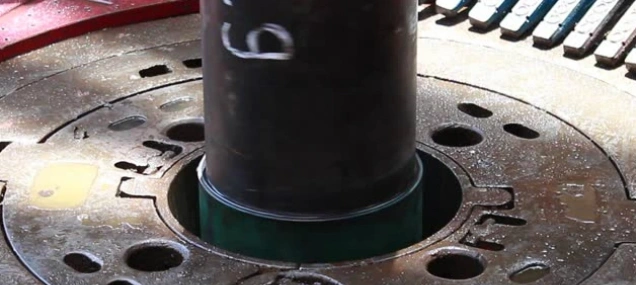
Casing While Drilling (CWD) technology is mainly used in drilling environments where formations are unstable, complex, or prone to collapse. It is highly effective in oil and gas wells, geothermal drilling, and other deep well applications where maintaining borehole integrity is difficult. By combining drilling and casing in one continuous operation, CWD improves efficiency, safety, and control in challenging subsurface conditions.
- Unstable Formations: CWD is widely used in weak, fractured, or unconsolidated geological formations where traditional drilling may cause borehole collapse or severe instability during operations.
- Oil and Gas Wells: It is commonly applied in exploration and production wells to reduce drilling risks, improve well control, and enhance overall operational efficiency in deep hydrocarbon reservoirs.
- Geothermal Drilling: CWD is ideal for high-temperature geothermal wells where maintaining borehole stability and reducing time loss are critical for cost-effective energy extraction.
- Offshore Drilling: This technology is used in offshore environments where well integrity, safety, and reduced non-productive time are essential due to high operational costs.
- Overburden Sections: CWD is effective in drilling overburden layers with varying pressure zones, helping maintain wellbore stability while minimizing formation damage and drilling complications.
Conclusion
In conclusion, Casing While Drilling (CWD) is a transformative technology that merges two critical operations—drilling and casing—into a single, highly efficient process. It offers dramatic improvements in wellbore integrity by providing immediate support to the open hole, thus mitigating risks like collapse, sloughing, and lost circulation which plague conventional drilling methods. This technique is especially valuable in unstable or challenging geological formations.
The key competitive advantage of adopting CwD lies in the significant reduction of non-productive time (NPT) and overall project costs. Eliminating the need for separate trips to pull the drill string and run the casing streamlines operations, while the enhanced stability often allows for deeper casing setting depths. This superior performance translates directly into faster well delivery and improved economic returns.
To integrate the efficiency of CwD into your operations, start with reliable, high-quality tools. Get in touch with Sinodrills today for wholesale pricing on drill bits, retractable systems, and drill rods. Equip your rig for maximum performance and cost savings! Contact Sinodrills now!