
Drilling into rock requires precision, and the angle of your drill bit is the single most critical factor determining success. We understand that an incorrectly sharpened or worn bit reduces penetration, increases heat, and dramatically shortens bit life. A reliable drill bit angle guide ensures your tools maintain the perfect geometry for hard rock applications.
Using a drill bit angle guide is a non-negotiable step for any professional drilling operation seeking efficiency. This guide ensures the correct point angle is set, minimizing the risk of the bit “walking” and maximizing the force directed into the rock. We provide solutions that lead to faster, cleaner holes and superior overall productivity.
What is Rock Drill Bit Angle?
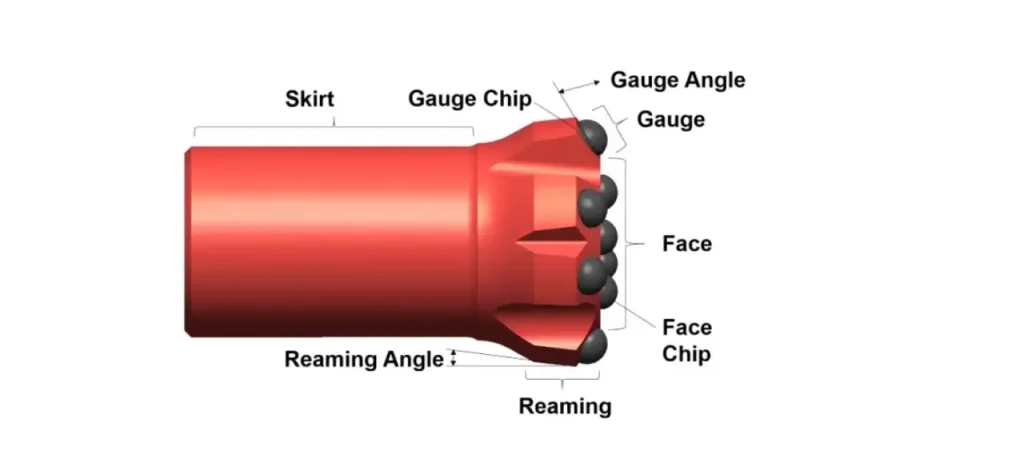
The rock drill bit angle, often called the point angle or apex angle, is the included angle formed at the cutting tip of the drill bit.
We understand this angle is crucial as it determines how the bit penetrates the rock, manages heat, and resists wear. Flatter angles (e.g., 135° or more) are preferred for hard, abrasive rock, as they distribute force over a wider area for improved durability.
Popular Rock Drill Bit Gauge Angles
The gauge angle in rock drilling, especially for roller cone and PDC bits, refers to the angles of elements designed to maintain the hole diameter, known as the gauge. While the point angle cuts the main hole, these gauge elements maintain the wall. We ensure our bits have optimized gauge angles to resist wear, prevent hole deviation, and maximize the overall lifespan of the bit in abrasive rock.
- Flatter Gauge Angles (e.g., 34° to 39° Journal Angle) We utilize flatter gauge angles, often seen as a higher journal angle in roller cones, for drilling hard, abrasive formations. This design minimizes the lateral scraping and gouging action of the gauge elements against the rock wall. This reduced abrasion dramatically slows down gauge wear, helping the bit drill a full-gauge hole consistently and for longer durations.
- Steeper Gauge Angles (e.g., 30° to 33° Journal Angle) For drilling in soft to medium-hard rock, we employ steeper gauge angles. A lower journal angle provides a greater scraping and shearing action at the gauge contact point, which is beneficial for faster material removal in less-resistant formations. This design helps clean the hole and facilitates a quicker penetration rate, maximizing efficiency in soft rock types.
- Specialized Back Rake Angles (e.g., 15° to 45° Back Rake) For specialized Polycrystalline Diamond Compact (PDC) bits, the cutter back rake angle is critical. We vary this angle from about 15 degrees (more aggressive ROP) to 45 degrees (more durable). A flatter back rake (higher degree) spreads the load over the cutter, increasing wear resistance for hard rock, while a sharper angle is used for faster drilling in softer rock.
Popular Rock Drill Bit Taper Degrees
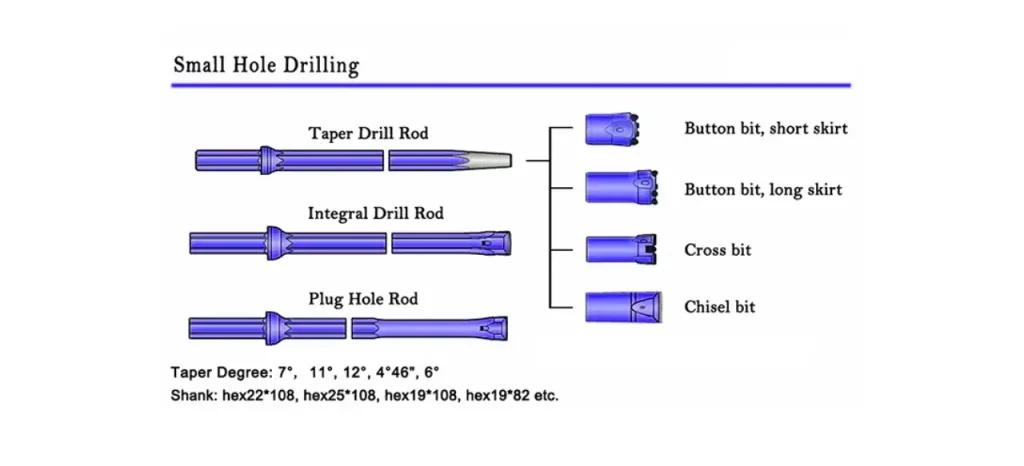
The taper degree is a vital specification for tapered rock drill bits, as it defines the angle of the conical connection between the bit and the drill rod. We utilize specific taper angles to optimize the transmission of the percussive energy from the rock drill to the bit face. This ensures the bit is securely held, yet easy to detach, balancing impact energy transfer with quick bit changes in the field.
- 7-Degree Taper: We commonly supply the 7-degree taper for use with low-impact rock drills or when working in medium to hard rock formations. This relatively narrow taper angle offers a very strong mechanical connection, which is beneficial for excellent energy transfer. It minimizes the risk of the bit rotating independently from the rod, leading to consistent, accurate drilling performance.
- 11-Degree Taper: The 11-degree taper is widely used in quarrying and for heavy-duty handheld rock drills, often targeting hard to very hard rock. We provide this angle because it strikes a practical balance, offering sufficient energy transfer while simplifying the process of decoupling the bit and rod. This feature is particularly valued in high-production drilling environments where speed is key.
- 12-Degree Taper: We offer the 12-degree taper primarily for use with modern, high-impact hydraulic rock drills in very hard rock formations. This wider taper angle is designed for maximum ease and speed of coupling and uncoupling, making it ideal for highly mechanized operations. Though the angle is steeper, the high power of modern rigs compensates for any slight reduction in pure energy transfer efficiency.
Tapered button drill bits come in various taper angles to match specific drilling requirements. The taper degree affects how the bit locks into the drill and transfers torque, which impacts drilling efficiency and safety.
Selecting the correct taper ensures stable operation and optimal performance for different rock hardness and drilling conditions.
Tapered Drill Bit Degrees Chart
| Tapered Degree | Application / Notes |
|---|---|
| 4° | Light to medium drilling, easier removal |
| 6° | Medium drilling, standard in many rigs |
| 7° | Common for quarrying and hard rock |
| 11° | Heavy-duty applications, deeper penetration |
| 12° | Specialized high-torque operations |
We offer all these tapered degrees, ensuring compatibility with various drill rigs and providing durability, precision, and reliable performance for mining, construction, and quarry projects.
How to Find the Suitable Rock Drill Bit Angles?
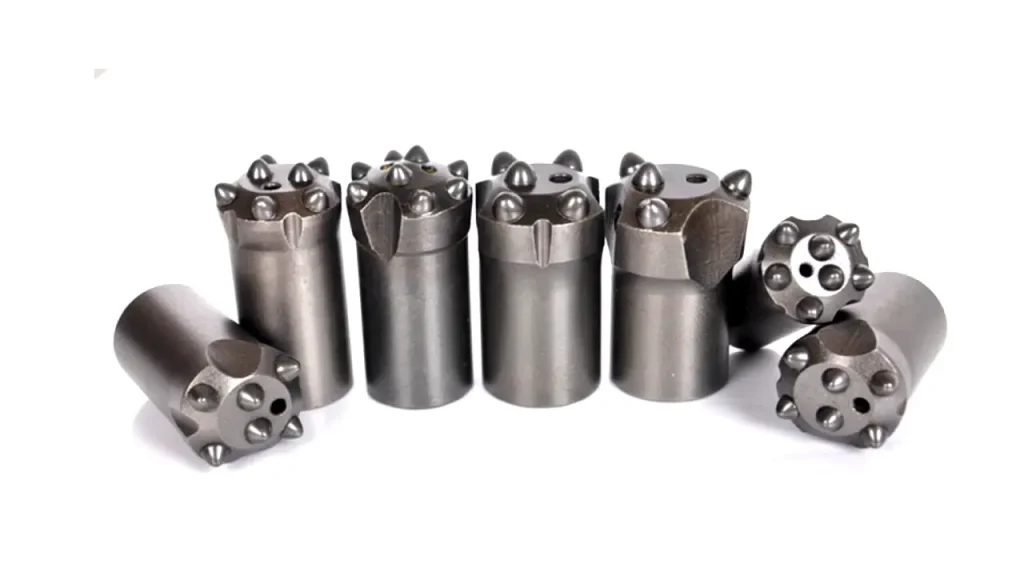
Selecting the suitable rock drill bit angle is essential for optimizing your drilling operation, ensuring both efficiency and tool longevity. We determine the best angle by analyzing the rock’s physical properties, the type of drilling equipment used, and the job’s primary objective.
Matching the point angle to the rock formation is key to achieving a high rate of penetration (ROP) while controlling bit wear.
- Assess Rock Hardness: The hardness and abrasiveness of the rock are the most influential factors. We know that hard, abrasive rock formations, such as granite or quartzite, require a flatter point angle (e.g., 135° to 150°). This angle distributes the cutting force, reducing stress on the inserts and extending the bit’s service life in punishing conditions.
- Consider Drilling Objective: Your drilling goal influences the angle selection. If maximum rate of penetration (ROP) is the priority in softer formations, we utilize a steeper angle (e.g., 110° to 125°), which cuts more aggressively. Conversely, for deep holes or where bit longevity is critical, a flatter, more durable angle is always the better choice.
- Evaluate Bit Type and Design: The actual design of the drill bit, such as chisel, cross, or button type, is interconnected with the recommended angle. We ensure that for hard rock, the bit design, combined with a flatter angle, provides the necessary structure to crush the formation effectively. The point geometry must match the formation to prevent the bit from “walking.”
Conclusion
The proper use of a drill bit angle is foundational to successful and cost-effective rock drilling. We have shown that maintaining the correct bit geometry is not just about extending the life of your tools; it is primarily about achieving consistent, powerful penetration and ensuring accurate hole placement in challenging formations. This attention to angle detail is what sets professional operations apart.
We recognize that having the right tools, including a reliable degrees of rock drill bits, goes hand-in-hand with sourcing superior drilling components. To fully capitalize on the efficiency gained from perfectly angled bits, you need durable, consistently manufactured components. That is why we invite you to get wholesale drill bits from our Sinodrills selection, ensuring unmatched quality and performance.
By choosing Sinodrills for your supply needs, you are partnering with a provider focused on durability and precision engineering. We offer a comprehensive inventory of drill bits that are ready for the most demanding rock conditions. Get custom drill bits from our Sinodrills range today to see how our commitment to materials and quality can transform your drilling output and overall operational success.